

What is a Statement?
A statement shows all the activity on your account for a period (Statement Period). It includes how much you’ve spent, the amount you need to pay, the date by which the payment must be received and how to make that payment.
We will generally send or make a statement of account available to you each month.
Accessing and managing your statements
If you’re enrolled for electronic statements, we'll send you an email or SMS to the email address or mobile number we have for you on the credit card account, to let you know when your statement is available. You can view your statement via the MyCard App or MyCard Online. You can view and download up to seven years’ worth of statements.
How to view your statements online
- Log in to the MyCard App or MyCard Online
- Select More
- Under Statements, select View statements
- Your statement will appear as a PDF file, which you can download.
How to manage preferences
To view or manage how you receive statements – i.e. online only, or paper statements:
- Log in to the MyCard App or MyCard Online
- Select More
Under Statements, select Set statement preferences and follow the prompts.
How to view your letters online
Where possible, we will communicate with you about your card or account via electronic channels like email. You will still need to maintain a current mailing address with us, as we can’t use electronic channels for all communication. You can manage your preference for electronic communication via the MyCard App or MyCard Online.
To view letters online:
- Log in to the MyCard App or MyCard Online
- Select More
- Under Documents, select View letters
How to read your Credit Card Statements
- Credit Card Statements
- Instalment Plan & Balance Transfer statements
This is what your Credit Card Statement looks like and how to read it.
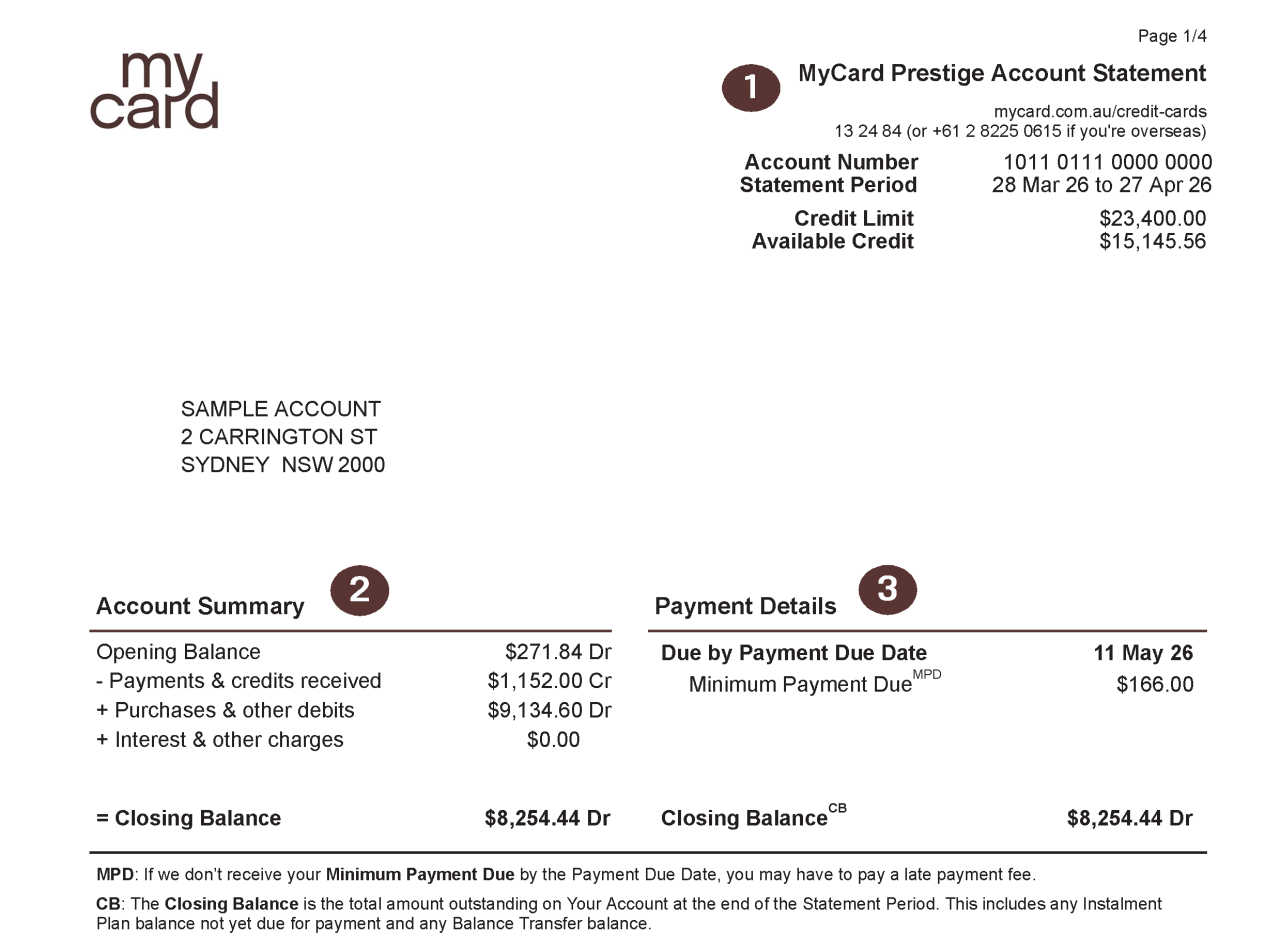
1. General MyCard Credit Card account details
This section includes your account number, statement period, credit limit and available credit.
Account Number
Your 16-digit credit card account number. This is not the same as the 16-digit card number on your credit card plastic.
Statement Period
The start and end date of the period which is covered by this statement.
This is a set period of time we use to record activity on your account ending on the same day each month even if it is a non-Business Day.
Credit Limit
The maximum amount of credit we tell you in writing you can have on your account.
Available Credit
The available credit is the amount left from your credit limit at the end of this statement period after taking away what you’ve already spent. If the amount is positive, you still have credit to use. If it’s negative, you’ve gone over your limit and can’t use your card until you pay some off.
2. Account Summary
This section tells you how much you owed at the start of this period (your opening balance), and how much got added or reduced from that amount, to arrive at the closing balance at the end of the statement period.
The closing balance is the total amount outstanding on your account at the end of the statement period.
3. Payment Details
This section tells you the amount due by the due date to keep your account in good standing and any amounts that need to be paid immediately (if your account is overdue and/or overlimit).
It also tells you what you may choose to pay beyond just the minimum to keep your account in good standing, e.g. if you want to continue receiving an interest free period, or at the maximum - if you want to pay off your entire debt, which may include amounts that are not yet due (i.e. outstanding Balance Transfers and Instalment Plan amounts).
Minimum Payment Due
The Minimum Payment Due is the minimum amount you need to pay by the payment due date to keep your account up to date. You will also need to pay any Overlimit Amount or Overdue Amount immediately.
The Minimum Payment Due is:
- the greater of:
- $25, or if the Card Balance as at the end of the Statement Period is less than $25, the Card Balance; or
- 2.00% of the Card Balance as at the end of the Statement Period (rounded up to the nearest dollar);
- plus, any Monthly Instalment, Initial Interest Charge, Instalment Fee or related interest on any of them, that is part of an Instalment Plan for that Statement Period.
Overdue/Overlimit Amount
Overdue Amount means any Minimum Payment due from a previous statement that wasn't paid on time and remains unpaid.
Overlimit Amount means the amount by which your account balance exceeds your Credit Limit. These are due and payable immediately from the date you exceeded the Credit Limit.
Total Minimum Payment Due
This is the sum of the Minimum Payment Due (which is payable by the Payment Due Date) and any Overdue/Overlimit amount (which is payable immediately).
If you have both an overdue and overlimit amount owing at the end of this statement period, only the higher of the two amounts will be included.
If you pay the Total Minimum Payment Due your account will be in good standing.
Failure to pay the minimum payment due can result in late payment fees being charged to your account. Continuing to miss the minimum payment due may result in your account being blocked.
Closing Balance
This is the total amount you owe on your account as at the date shown on this statement. It includes all Instalment Plan and Balance Transfer amounts that are included in the closing balance and will need to be paid in the future.
If your product has Interest Free Days and you do not have an active Balance Transfer or Instalment Plan on your account, this is the amount you need to pay by the payment due date to avoid being charged interest on retail purchases. If you do have a Balance Transfer or Instalment Plan, or both on your account, refer to the next tab.
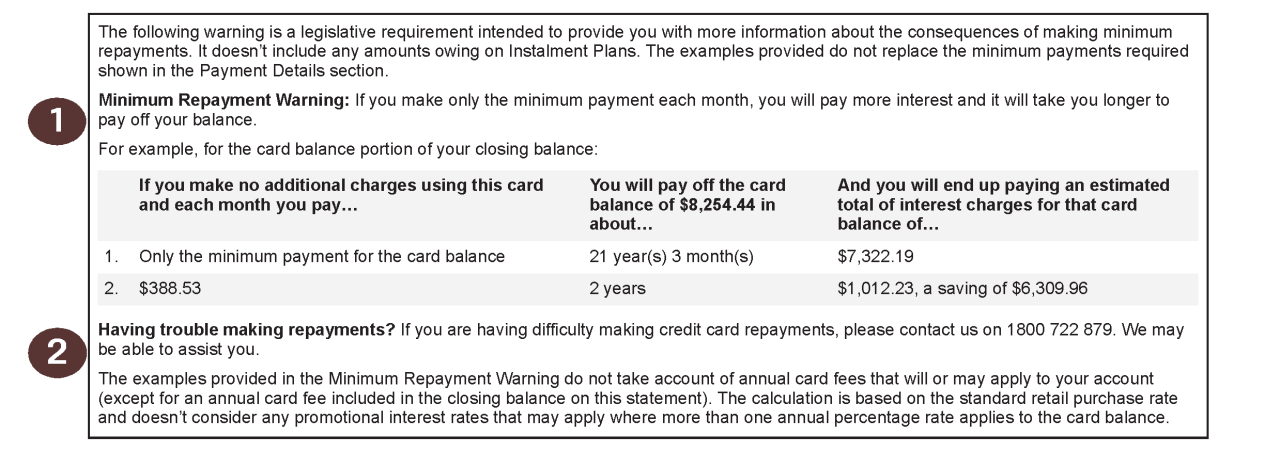
Your Minimum Repayment Warning
1. Minimum Repayment Warning
This illustrates the time it may take to pay your closing balance less any Instalment Plan payments due in the current month or in future months.
2. Trouble with repayments
If you’re struggling with your finances, it’s important that you reach out to us as soon as you can to understand your situation and consider Financial Hardship Assistance options available to you. You can contact us within Australia on 1800 722 879. We’re available Monday to Friday, 8am to 8pm and Saturday, 9am to 1pm (AEST/AEDT).
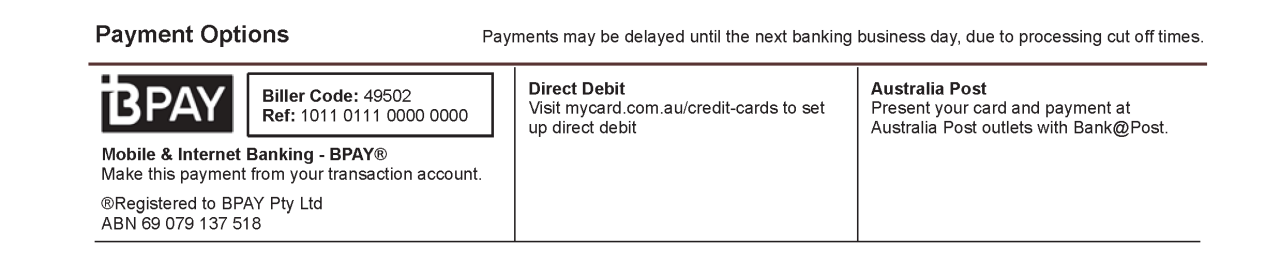
Payment Options
This section provides options for credit card payments, including your biller codes, direct debit and payment at Australia Post.
View our guide for more details and instruction on how to pay off your MyCard Credit card.
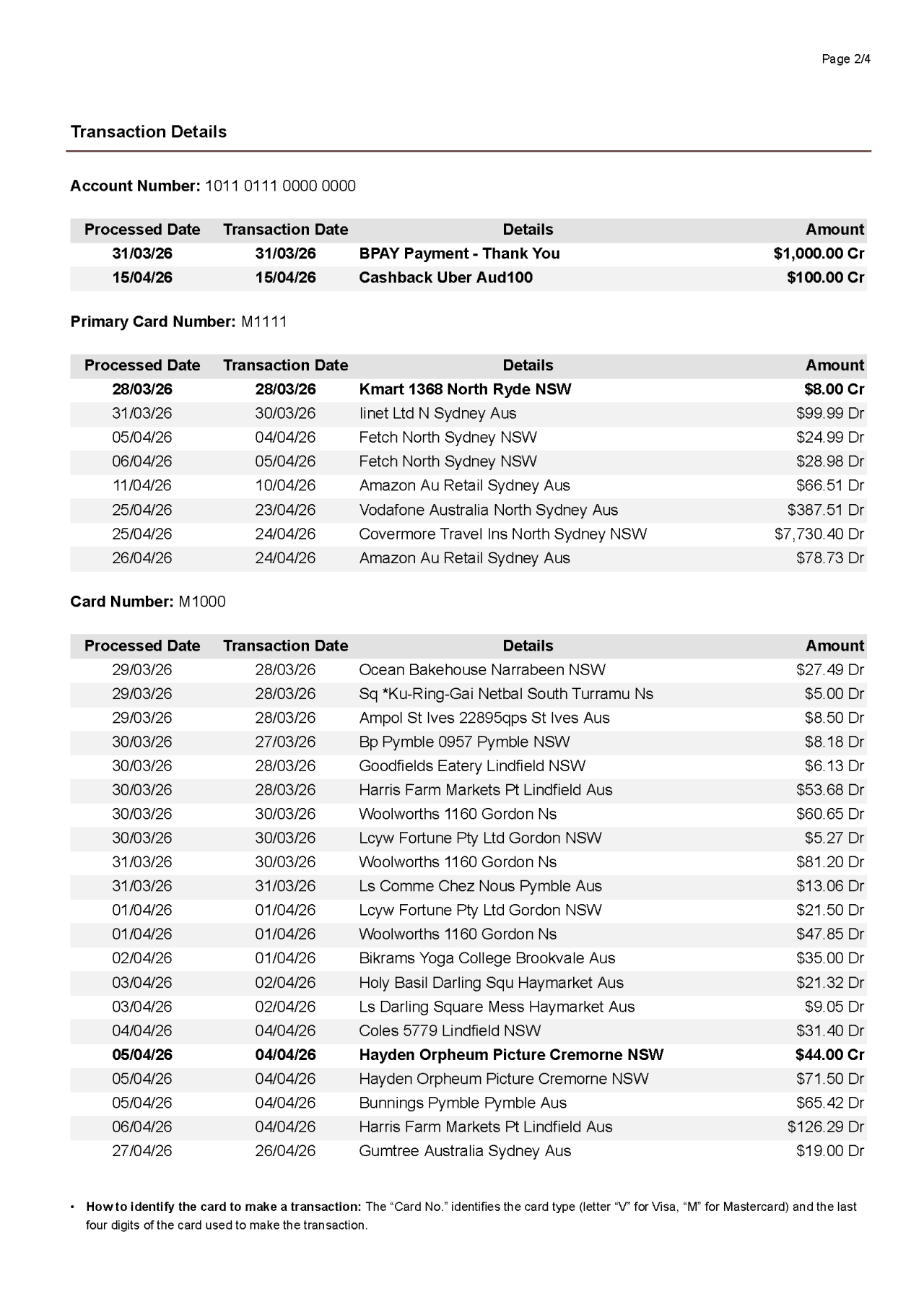
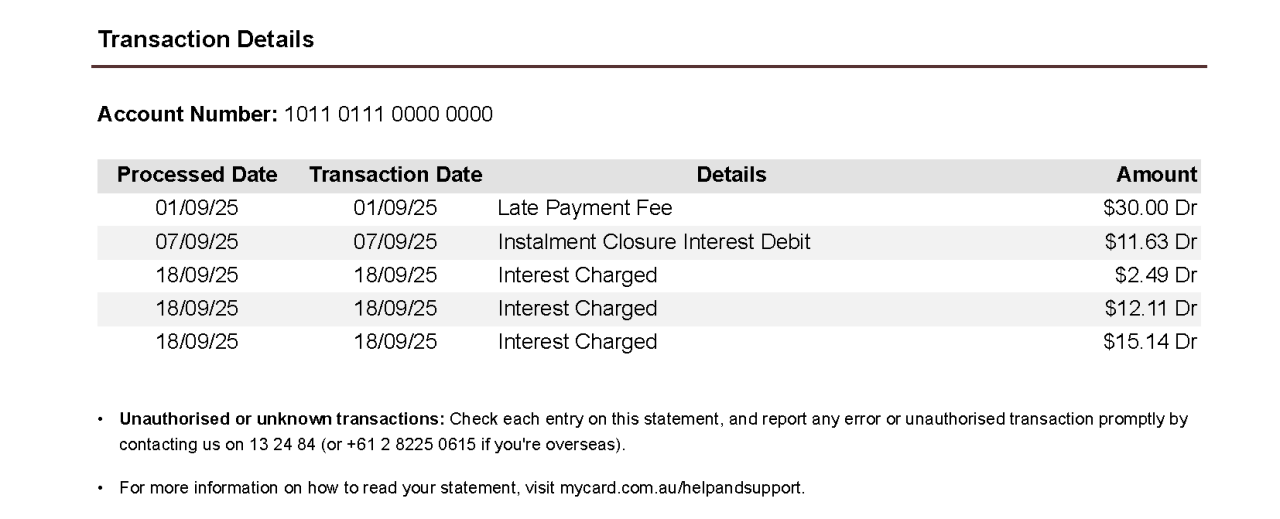
Transaction details
This section includes details of all purchases, cash advances, interest and fees charged to your account as well as repayments made to the account.
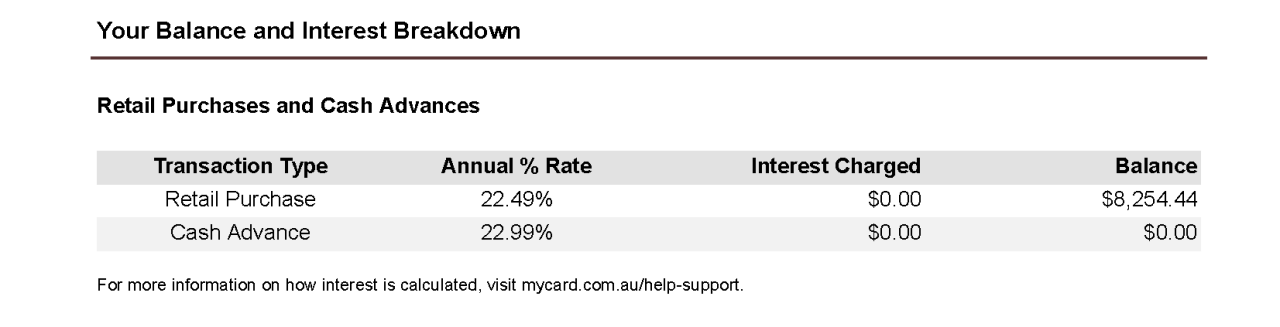
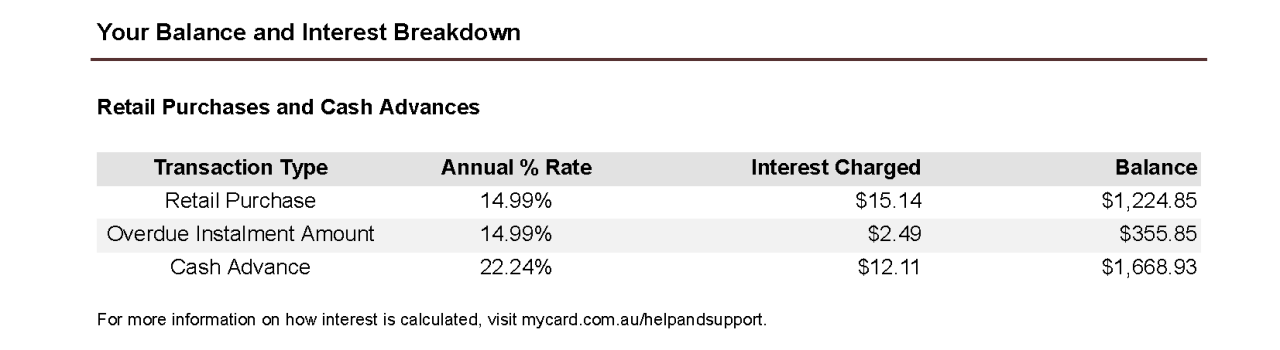
Your Balance and Interest Breakdown
This section shows how your total balance is made up and how interest is applied to different types of transactions on your card.
If you have an Instalment Plan or Balance Transfer, this is what your statement will look like.
Your Credit Card Account Summary
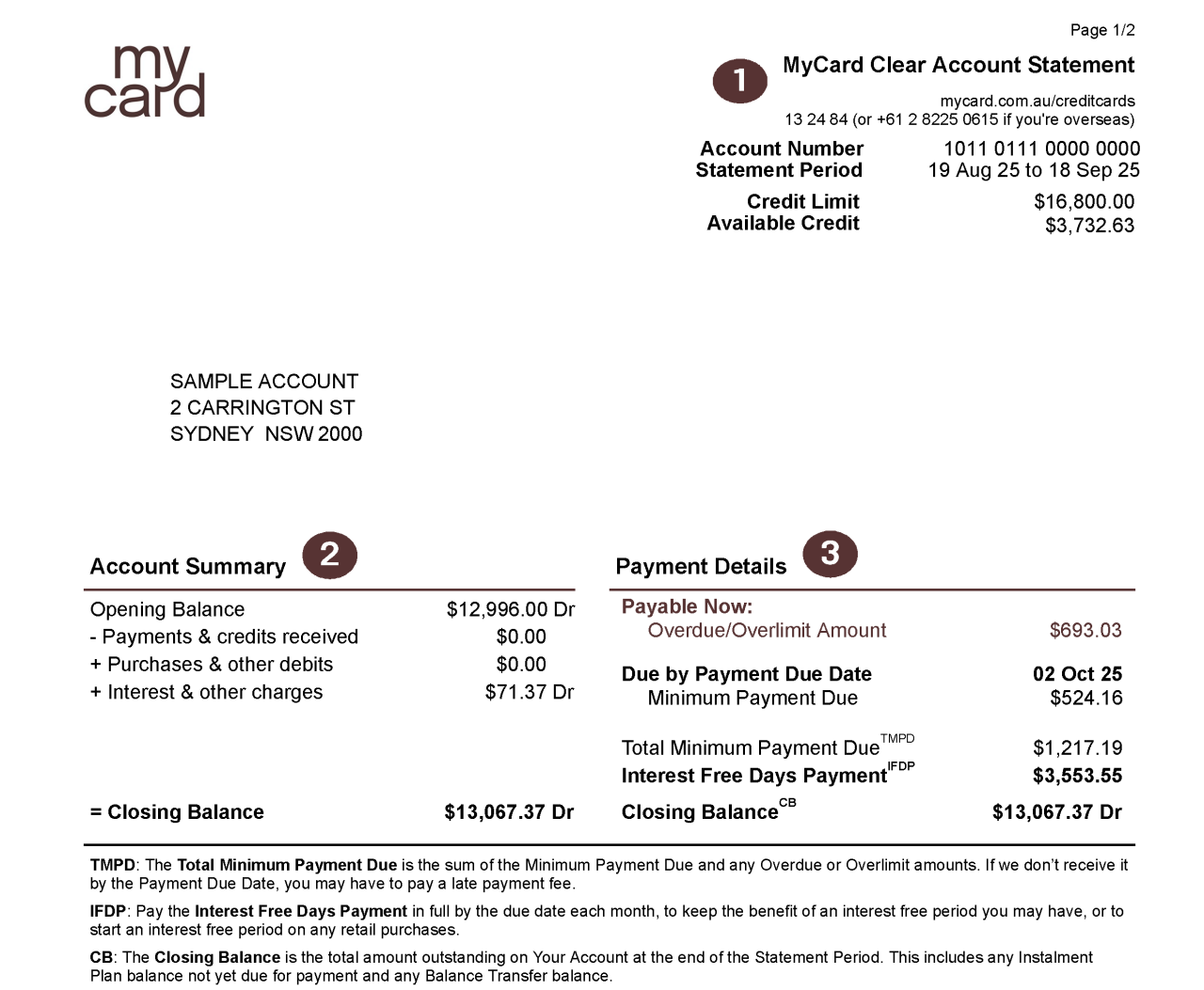
1. General MyCard Credit Card account details
This section includes your account number, statement period, credit limit and available credit.
Your 16-digit credit card account number. This is not the same as the 16-digit card number on your credit card plastic.
Statement Period
The start and end date of the period which is covered by this statement.
This is a set period of time we use to record activity on your Account ending on the same day each month even if it is a non-Business Day.
Credit Limit
The maximum amount of credit we tell you in writing you can have on your account.
Available Credit
The available credit is the amount left from your credit limit at the end of this statement period after taking away what you’ve already spent. If the amount is positive, you still have credit to use. If it’s negative, you’ve gone over your limit and can’t use your card until you pay some off.
2. Account Summary
This section tells you how much you owed at the start of this period (your opening balance), and how much got added or reduced from that amount, to arrive at the closing balance at the end of the statement period.
The closing balance is the total amount outstanding on your account at the end of the statement period.
3. Payment Details
This section tell you amount due by the due date to keep your account in good standing and any amounts that need to be paid immediately (if your account is overdue and/or overlimit)
It also tells you what you may choose to pay beyond just the minimum to keep your account in good standing, e.g. if you want to continue receiving an interest free period, or at the maximum - if you want to pay off your entire debt, which may include amounts that are not yet due (i.e. outstanding Balance Transfers and Instalment Plan amounts).
Minimum Payment Due
The Minimum Payment Due is the minimum amount you need to pay by the payment due date to keep your account up to date. You will also need to pay any Overlimit Amount or Overdue Amount immediately.
The Minimum Payment Due is:
- the greater of:
- $25, or if the Card Balance as at the end of the Statement Period is less than $25, the Card Balance; or
- 2.00% of the Card Balance as at the end of the Statement Period (rounded up to the nearest dollar);
- plus, any Monthly Instalment, Initial Interest Charge, Instalment Fee or related interest on any of them, that is part of an Instalment Plan for that Statement Period.
Overdue/Overlimit Amount
Overdue Amount means any Minimum Payment due from a previous statement that wasn't paid on time and remains.
Overlimit Amount means the amount by which your account balance exceeds your Credit Limit. These are due and payable immediately from the date you exceeded the Credit Limit.
Total Minimum Payment Due
This is the sum of the Minimum Payment Due (which is payable by the Payment Due Date) and any Overdue/Overlimit amount (which is payable immediately).
If you have both an overdue and overlimit amount owing at the end of this statement period, only the higher of the two amounts will be included.
If you pay the Total Minimum Payment Due your account will be in good standing.
Failure to pay the minimum payment due can result in late payment fees being charged to your account. Continuing to miss the minimum payment due may result in your account being blocked.
Interest Free Days Payment
The interest-free days payment is the amount you should pay to keep the benefit of an interest-free period on retail purchases, or to start an interest free period on any retail purchases.
If you have a balance transfer, you should try to pay more than the interest-free days payment each month if you want to repay the balance within the promotional interest rate period.
Closing Balance
This is the total amount you owe on your account as at the date shown on this statement. It includes all Instalment Plan and Balance Transfer amounts that are included in the closing balance and will need to be paid in the future.
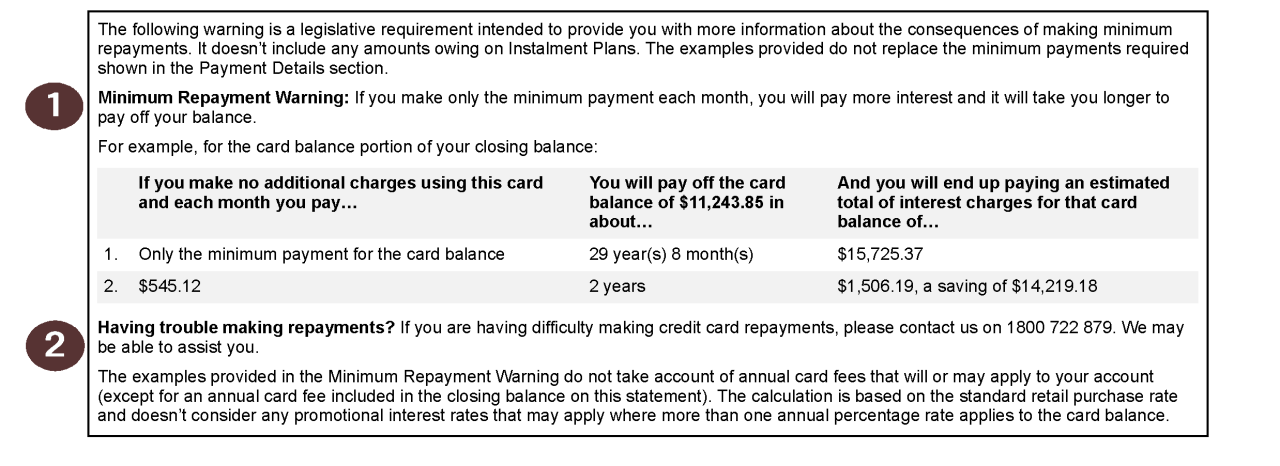
Your Minimum Repayment Warning
1. Minimum Repayment Warning
This illustrates the time it may take to pay your closing balance less any Instalment Plan payments due in the current month and future months.
2. Trouble with repayments
If you’re struggling with your finances, it’s important that you reach out to us as soon as you can to understand your situation and consider Financial Hardship Assistance options available to you. You can contact us within Australia on 1800 722 879. We’re available Monday to Friday, 8am to 8pm and Saturday, 9am to 1pm (AEST/AEDT).
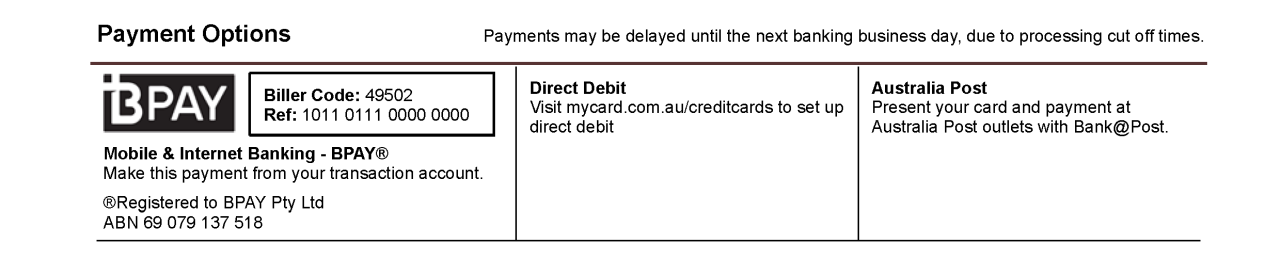
Payment Options
This section provides options for credit card payments, including your biller codes, direct debit and payment at Australia Post.
View our guide for more details and instruction on how to pay off your MyCard Credit card.
Transaction details
This section includes details of all purchases, cash advances, interest and fees charged to your account as well as repayments made to the account.
Your Balance and Interest Breakdown
This section shows how your total balance is made up and how interest is applied to different types of transactions on your card.
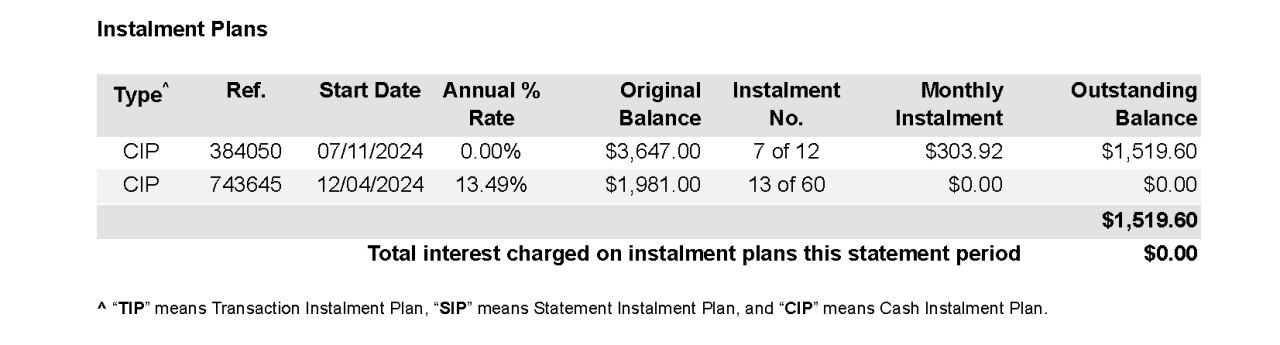
Instalment Plan summary
If you have Instalment Plans on your account you will see the following summary on your statements. You can also find information about your Instalment Plans in the MyCard app or MyCard Online.
If you have multiple Instalment Plans on your account, each will be displayed on a new line.
Type
This tells you the kind of Instalment Plans you are on. “TIP” means Transaction Instalment Plan, “SIP” means Statement Instalment Plan, and “CIP” means Cash Instalment Plan.
Ref
A reference number used to identify this specific Instalment Plans.
Start Date
The date your Instalment Plans began.
Annual % Rate
The interest rate applied to your Instalment Plans per annum.
Original Balance
The total amount that was originally placed into an Instalment Plan.
Instalment No.
Shows your progress through the plan. For example, “11 of 12” means your 11th monthly instalment payment is due with one monthly repayment remaining.
Monthly Instalment
The monthly instalment amount you pay each month for this plan.
Outstanding Balance
The amount still left to repay on the Instalment Plan excluding any overdue instalment amounts or instalment plan amounts due by the payment due date on this statement.
Total interest charged on Instalment Plans this statement period
This confirms how much interest was charged on your Instalment Plans for this statement. It includes any initial interest charged this statement period and excludes any interest on overdue instalment amounts which is shown separately in Your Balance and Interest Breakdown.
Balance Transfer summary
If you have a Balance Transfer on your account you will see the following summary on your statements.
If you have multiple Balance Transfers on your account, each Balance Transfer will be displayed on a new line.

Start Date
The date your Balance Transfer began.
Expiry Date
The date your Balance Transfer offer ends. After this date, any remaining balance will be charged interest at the standard cash advance rate that applies to your account.
Annual % Rate
The interest rate applied to this balance transfer per annum. In this example, it’s 0.00% as the Balance Transfer promotional offer period hasn’t ended yet.
Outstanding Balance
The amount you still have left to repay on this Balance Transfer.
Contact us
Feedback and complaints
Contact us to provide feedback or if you wish to make a complaint.